GCC Resident Visa For Qatar 2026: Requirements & Fees
If you live and work in a Gulf Cooperation Council (GCC) country but don’t hold citizenship there, you’re classed as a GCC resident — and Qatar’s Ministry of Interior (MOI) has built a dedicated visa system just for you. Whether you’re a Pakistani accountant based in Dubai, an Indian engineer working in Riyadh, or a Filipino nurse residing in Bahrain, the GCC resident visa gives you a fast, affordable way to enter Qatar for tourism, business, or family visits.
Issued and regulated by the MOI Qatar, this visa can be obtained either on arrival at the airport or in advance through the official Hayya portal — both of which fall under the Ministry of Interior’s digital visa services. In this guide, we’ll walk through everything tied to the MOI Qatar visa system: eligibility, documents, fees, processing time, and how to check your application status directly on the MOI Qatar portal.
What is a GCC Resident Visa?
A GCC resident visa is a special entry permit that Qatar (and other Gulf states) offers to foreign nationals who legally reside in a fellow GCC member country — Saudi Arabia, UAE, Kuwait, Bahrain, or Oman — even though they are not citizens of that country.
In Qatar, this visa exists in two main forms:
- Visa on Arrival for GCC Residents — issued at the airport with no advance application.
- Hayya A2 Visa (GCC Resident Visa) — applied for online in advance through the Hayya platform.
The visa is officially designated Category A2 on Qatar’s Hayya portal, distinct from the standard tourist visa (A1) and the companion visa for travelers accompanying a GCC citizen (A4).
Key takeaway: GCC citizens (nationals of Saudi Arabia, UAE, Kuwait, Bahrain, Oman, and Qatar) never need a visa for Qatar — they enter on their national ID. The “GCC resident visa” is specifically for non-citizen expats living in a GCC country.
Who Can Apply?
You’re eligible to apply for the GCC resident visa to Qatar if:
- You hold a valid residence permit (Iqama, Emirates ID, or equivalent) issued by Saudi Arabia, UAE, Kuwait, Bahrain, or Oman.
- You are not a citizen of the GCC country you reside in (this category doesn’t apply to GCC nationals, who already travel visa-free).
- Your profession is listed on Qatar’s approved occupations list (for Visa on Arrival) or you meet the general entry conditions (for the Hayya A2 online visa).
- You’re traveling for tourism, business, family visits, or transit — not for employment in Qatar.
This visa is commonly used by:
- Foreign workers based in the GCC who want a weekend or holiday trip to Qatar
- Families of GCC residents visiting together
- Business travelers attending meetings, conferences, or exhibitions
- Students studying in a GCC country who want to travel during breaks
Eligibility Requirements
Core eligibility criteria
| Requirement | Details |
|---|---|
| Residency status | Valid residence permit in Saudi Arabia, UAE, Kuwait, Bahrain, or Oman |
| Passport validity | Minimum 6 months remaining from date of entry |
| Residence permit validity | Minimum 3–6 months remaining (varies by route and is stricter for the Hayya A2 online visa) |
| Profession | Must appear on Qatar’s approved professions list (Visa on Arrival route) |
| Travel route | Generally must travel directly from the GCC country of residence |
| Health insurance | Mandatory for all visitors; required for any stay beyond 30 days |
Approved professions for Visa on Arrival
Qatar maintains an official list of eligible job titles drawn from your GCC residence permit. Approved categories include, among others:
- Doctors, engineers, lawyers, judges, professors, scientists
- CEOs, bank managers, hotel managers, financial analysts, auditors, accountants
- IT experts, consultants, advisors, diplomats
- Pilots, ship captains, air traffic controllers
- Writers, TV directors, archaeologists, geologists, chemists, veterinarians
Important: If your residence permit lists a job title such as salesman, clerk, driver, or laborer, you will not qualify for the Visa on Arrival. In that case, you should apply for the Hayya A2 visa online instead, which has more flexible eligibility for many professions not on the on-arrival list.
If you’re traveling with a GCC citizen sponsor, you may instead apply under the separate Companion of GCC Citizen visa (A4). Non-GCC family members without their own GCC residency can apply for the standard Tourist Entry visa (A1).
Required Documents
Across both the Visa on Arrival and Hayya A2 online routes, you’ll typically need:
- Valid passport (minimum 6 months validity from arrival date)
- GCC residence permit / ID (minimum 3 months validity remaining; some routes require up to 6 months)
- Recent passport-size photograph with a white background
- Confirmed return or onward flight ticket
- Proof of accommodation — hotel booking or an invitation letter from a host in Qatar
- Health insurance covering your stay in Qatar
- Proof of profession/employment, if requested (occasionally needed for online applications)
For family applications, each accompanying member needs their own passport, residence permit (if applicable), and photograph, plus supporting documents such as marriage or birth certificates to prove the relationship.
Quick document checklist
- Passport (6+ months valid)
- GCC residence permit (3–6 months valid)
- Passport-size photo
- Return ticket
- Hotel booking or invitation letter
- Health insurance proof
- Marriage/birth certificates (for family applicants)
Application Process Step by Step
Option 1: Visa on Arrival (at Qatar airport)
- Check your profession against Qatar’s approved occupations list before you travel.
- Book accommodation — for several nationalities (including India, Pakistan, Iran, Thailand, and Ukraine), hotels must be booked through the official Discover Qatar platform for visa-on-arrival eligibility.
- Travel directly from your GCC country of residence to Qatar.
- Arrive at the immigration counter and present your passport, GCC residence permit, return ticket, and accommodation proof.
- Pay the visa fee (QAR 100) by credit or debit card.
- Receive your visa stamp and proceed through immigration.
Option 2: Hayya A2 Visa (online application)
- Visit the Hayya website or download the “Hayya to Qatar” app.
- Create an account or log in.
- Select visa category A2 – GCC Resident Visa.
- Fill in the application form with your personal, passport, and residency details.
- Upload required documents — passport copy, GCC residence permit, photo, accommodation proof, return ticket.
- Pay the visa fee (QAR 100) online via credit/debit card.
- Wait for approval — typically 48 hours to 5 working days.
- Download and print your Hayya Entry Permit, valid for 90 days from issue date for actual travel.
Processing Time
| Visa Type | Processing Time |
|---|---|
| Visa on Arrival | Immediate (issued at the airport) |
| Hayya A2 (online) | 48 hours to 5 working days |
| Hayya A2 during peak events (e.g., major tournaments) | ~48 hours average, but apply early |
Tip: Always apply for the Hayya A2 visa at least a week before travel during high-demand periods such as major sporting events, Ramadan, or school holidays, since processing can slow down with surging applications.
Fees and Charges
| Item | Fee (QAR) | Approx. USD |
|---|---|---|
| GCC Resident Visa (Visa on Arrival / Hayya A2) | 100 | ~27 |
| Visa extension (per 30 days, Visa on Arrival route) | 200 | ~55 |
| Visa extension (per month, Hayya A2 route, up to 2 extra months) | 200 | ~55 |
| Overstay fine (per day) | 200 | ~55 |
| Basic health insurance (if not already covered) | 50 | ~14 |
All visa fees are non-refundable, even if you cancel your trip after payment.
Validity and Renewal
- Visa on Arrival: Valid for a 30-day stay, single entry, extendable once for another 30 days via the Metrash2 app.
- Hayya A2 Visa: As of the latest 2026 update, this visa now permits stays of up to two months and allows multiple entries for eligible GCC residents — an upgrade from the previous single-entry, one-month structure.
- Entry permit validity: The Hayya Entry Permit itself remains valid for 90 days from issue date, meaning you must enter Qatar within that window even though your stay once inside is shorter.
- Extensions: Available for both visa types for an added fee of QAR 200 per extra period, processed through the Metrash2 app or the MOI website before the current visa expires.
Warning: Extensions must be filed before your visa expires. Overstaying — even by one day — triggers a QAR 200/day fine and can affect future travel eligibility to Qatar.
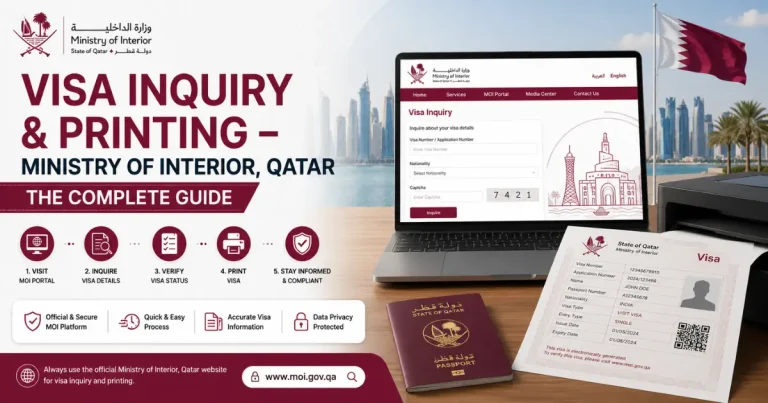
How to Check Visa Status on MOI Qatar Portal
You can track your GCC resident visa application or entry permit status using these official channels:
- Go to the Ministry of Interior (MOI) Qatar website (www.moi.gov.qa) or the Hayya portal.
- Select “Visa Check” or “Visa Inquiry” from the services menu.
- Enter your passport number and nationality, or your Hayya application reference number.
- Submit the form to view your current visa status — pending, approved, or rejected.
- Alternatively, use the Metrash2 mobile app, which allows residents and visa holders in Qatar to check visa status, request extensions, and manage other immigration services from a smartphone.
If your status shows as rejected or stuck in “pending” for an unusually long time, double-check your uploaded documents for errors before resubmitting.
Common Reasons for Rejection
- Profession not on the approved list for Visa on Arrival (e.g., labor or clerical job titles)
- Residence permit validity too short — less than the required 3–6 months remaining
- Passport validity below 6 months
- Incomplete or unclear document uploads (blurry scans, expired documents)
- Missing accommodation proof, especially for nationalities requiring Discover Qatar bookings
- Traveling indirectly rather than directly from your GCC country of residence
- Mismatched personal details between passport, residence permit, and application form
- No health insurance proof when required
Tips for Faster Approval
- Confirm your job title matches an approved profession before applying for Visa on Arrival.
- Apply for the Hayya A2 visa in advance if your profession isn’t listed, or if you simply want pre-travel certainty.
- Keep printed copies of all documents — some immigration counters still prefer physical paperwork over phone screenshots.
- Book accommodation well ahead of peak seasons like major tournaments or Ramadan.
- Double-check that your residence permit and passport meet minimum validity windows before booking flights.
- Purchase travel/health insurance even when not strictly mandatory — it smooths the process and protects you.
- Submit clear, high-resolution scans of every document during online application.
Frequently Asked Questions
What is a GCC resident visa for Qatar?
It’s a special entry permit (Hayya Category A2) that allows non-citizen residents of Saudi Arabia, UAE, Kuwait, Bahrain, or Oman to visit Qatar for tourism, business, or family purposes, either on arrival or via an online application.
Who is eligible for the GCC resident visa?
Anyone holding a valid residence permit in a GCC country (excluding their own citizenship there), with a passport valid for at least 6 months and a residence permit valid for at least 3–6 months, and whose profession meets the relevant route’s requirements.
What documents are required for the GCC resident visa?
A valid passport, your GCC residence permit, a recent photo, a return ticket, proof of accommodation, and health insurance. Family applicants also need supporting documents like marriage or birth certificates.
How can I apply for the GCC resident visa online?
Apply through the Hayya website or “Hayya to Qatar” app by selecting visa category A2, completing the form, uploading documents, and paying the QAR 100 fee. Approval generally takes 48 hours to 5 working days.
Can GCC residents get a visa on arrival in Qatar?
Yes — if their profession appears on Qatar’s approved occupations list, GCC residents can receive a 30-day visa on arrival at the airport for a QAR 100 fee, no advance application required.
What is the GCC resident visa fee?
The standard fee for both the Visa on Arrival and the Hayya A2 online visa is QAR 100 (approximately USD 27), payable by credit or debit card. This fee is non-refundable.
How long is the GCC resident visa valid?
The Visa on Arrival allows a 30-day stay, extendable once for another 30 days. The Hayya A2 visa now allows stays of up to two months with multiple entries, and the entry permit itself is valid for 90 days from issue for travel purposes.
Can I extend my GCC resident visa in Qatar?
Yes. Extensions are available through the Metrash2 app or the MOI website for an additional QAR 200 per extension period. You must apply before your current visa expires.
Is the GCC resident visa available for Pakistanis and Indians?
Yes. Nationality is not the main factor — what matters is that you hold valid residency in a GCC country. Many Pakistani and Indian nationals working in the UAE, Saudi Arabia, or other GCC states use this visa to visit Qatar.
Can my family apply for a GCC resident visa together?
Yes, but each family member must submit their own separate application with their own passport and residence permit (if held). Supporting documents proving the relationship, like marriage or birth certificates, are typically required.
How do I check my GCC resident visa status?
Use the MOI Qatar website’s visa inquiry tool, the Hayya portal’s visa check feature, or the Metrash2 app, entering your passport number and nationality or your application reference number.
What happens if I overstay my GCC resident visa?
You’ll be fined QAR 200 per day of overstay, and repeated or prolonged overstays can result in future travel bans or complications when applying for new visas to Qatar.
Is there a Unified GCC Tourist Visa for all six Gulf countries?
A Schengen-style Unified GCC Tourist Visa, covering Saudi Arabia, UAE, Qatar, Kuwait, Bahrain, and Oman with a single permit, is in its final rollout phase as of 2026 but has not fully replaced country-specific visas yet. Until it launches fully, GCC residents should continue using Qatar’s Visa on Arrival or Hayya A2 visa.
Final Verdict
The GCC resident visa is one of the simplest and most affordable ways for expats living in the Gulf to explore Qatar — whether that’s for a weekend trip, a business meeting, or a family holiday. For most applicants, the choice boils down to two paths: the Visa on Arrival, ideal if your profession is on the approved list and you want a fast, no-hassle entry; or the Hayya A2 online visa, the safer route if your job title isn’t listed or you simply prefer guaranteed approval before you fly.
Either way, success comes down to the basics: a passport and residence permit with enough remaining validity, the right supporting documents, and an application submitted well ahead of your travel date. Stay alert to the evolving rules — including the eventual rollout of the Unified GCC Tourist Visa — and you’ll continue to enjoy smooth, low-cost access to one of the Gulf’s most dynamic destinations.