Qatar ID Blacklist Check — How to Know if You Are Banned (2026 Guide)
If you live in Qatar or plan to travel there, one of the most stressful situations you can face is not knowing whether your Qatar ID (QID) has been flagged, blocked, or blacklisted. Thousands of expats and overseas workers face this uncertainty every year — especially those who have changed jobs, faced legal disputes, or previously left the country under difficult circumstances.
The problem is real. You could be denied entry at the airport, find your visa application rejected, or discover that your Qatar residence permit has been quietly cancelled — all without any formal warning.
This guide explains exactly what Qatar ID blacklisting means, why it happens, how to check your status through official channels like the Ministry of Interior (MOI) Qatar and the Metrash app, and what steps you can take if you find yourself on the wrong side of the system.
Important: All information here is for guidance only. For official confirmation of your immigration status, always consult the Qatar immigration department or a licensed legal professional.
⚡ Quick Answer
How to check if you are banned in Qatar:
- Visit the MOI Qatar portal at portal.moi.gov.qa
- Select “Visa Services” or “Residency Services”
- Enter your QID number or passport details
- Check your residency and visa status
Alternatively, download the Metrash2 app, log in with your QID, and check your ID and residency status directly from your phone.
If your status shows as “cancelled,” “blocked,” or “expired” without your knowledge, contact the MOI Qatar helpline at +974 2347444 or visit an immigration office for clarification.
What Is a Qatar ID Blacklist Check?
The Qatar ID blacklist is not a single official list with that exact name. Rather, it refers to a set of restrictions placed on an individual’s Qatar ID (QID) or passport within Qatar’s immigration and residency database — managed by the Ministry of Interior (MOI) Qatar.
When someone is “blacklisted” in Qatar, their QID or passport is flagged in the national immigration system. This can prevent them from:
- Entering Qatar (entry ban)
- Renewing or transferring their residency permit
- Changing jobs or sponsorship
- Obtaining a new visa
- Leaving the country freely (in some cases involving financial disputes)
The flag may be linked to your Qatar ID number, your passport number, or both. This is why even if you get a new passport, some bans may still follow you.
Reasons Why Someone Gets Blacklisted in Qatar
Understanding why bans happen is the first step to protecting yourself. Here are the most common reasons:
Legal and Criminal Issues
- Criminal conviction or ongoing legal case in Qatar
- Unpaid fines, court-ordered payments, or financial fraud
- Violating Qatar’s cybercrime, alcohol, or public conduct laws
Immigration Violations
- Overstaying your visa or residency permit
- Entering Qatar on a tourist visa and working illegally
- Providing false information in a visa or residency application
Labor and Employment Issues
- Absconding from a sponsor or employer (leaving a job without following legal process)
- Filing a labour complaint that resulted in a counter-complaint against you
- Violating the terms of your work permit
Deportation History
- Being deported from Qatar previously places a near-automatic ban on re-entry
- The ban duration depends on the severity of the reason
Sponsor-Initiated Bans
- Some employers or sponsors can request a ban or flag through MOI if they believe an employee has violated the contract
- This is especially common during disputes between workers and employers
Warning: Qatar’s immigration system can apply bans without sending formal notifications to the individual. You may not know you are banned until you try to enter the country or apply for a visa.
How to Check Qatar Blacklist Status Online
There are several official ways to check your Qatar QID status or immigration ban status. No single tool is labeled “blacklist checker,” but the following methods give you the most accurate and up-to-date information.
Method 1: MOI Qatar Online Portal
The MOI Qatar portal is the primary official platform for immigration and residency-related services.
Steps:
- Go to portal.moi.gov.qa
- Navigate to “Visa & Residency” or “Inquiries”
- Select “Residency Status Inquiry” or “Visa Status Inquiry”
- Enter your QID number or passport number and nationality
- Review the result — if it shows “cancelled,” “blocked,” or no active status, this is a major red flag
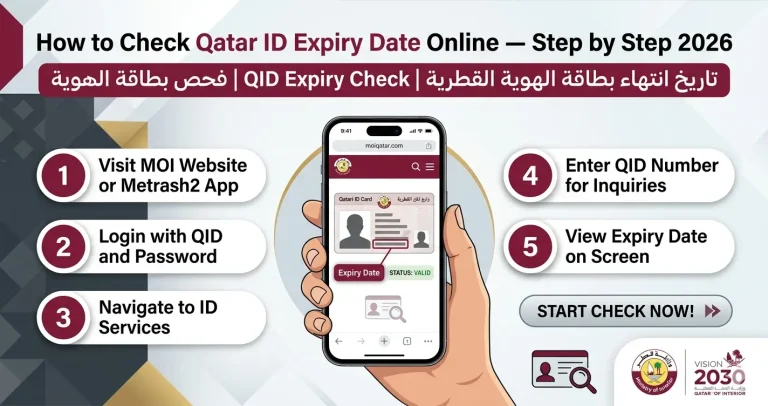
Method 2: Metrash2 App
The Metrash2 app, developed by MOI Qatar, is an official government app available on iOS and Android. It’s one of the easiest ways to check your Qatar ID and residency status.
Steps:
- Download Metrash2 from the App Store or Google Play
- Register using your QID number and mobile number
- Log in and navigate to “My Services”
- Check “My ID Card” and “My Residency” sections
- An active status means your ID is valid; a cancelled or missing status warrants investigation
Method 3: Contact MOI Directly
If online tools give unclear information, call MOI Qatar directly:
- Helpline: +974 2347444 (or 109 within Qatar)
- Email: Submit a query via the official MOI website contact form
- In Person: Visit the General Directorate of Passports and Expatriates Affairs in Doha
Method 4: Check Through Your Employer or PRO
If you are in Qatar on a work visa, your company’s Public Relations Officer (PRO) can often check your residency and visa status through employer-side MOI portals. If you suspect a problem, ask your PRO to verify your QID status immediately.
Method 5: Qatar Immigration Department
For more serious concerns — especially about travel bans or deportation records — visit the Qatar immigration department in person at the Ministry of Interior offices in Doha. Bring your original passport and Qatar ID.
MOI Qatar Blacklist Check — Step-by-Step
Here is a consolidated walkthrough for those who want to do a comprehensive MOI Qatar blacklist check:
Step 1: Open portal.moi.gov.qa in your browser.
Step 2: Choose your preferred language (Arabic or English).
Step 3: Click on “Inquiries” from the top navigation menu.
Step 4: Select “Residency Permit Inquiry” or “Visa Inquiry” depending on your situation.
Step 5: Enter your Qatar ID number (for residents) or passport number + nationality (for non-residents or those outside Qatar).
Step 6: Complete any CAPTCHA or verification step.
Step 7: Review your status:
- Active = No restriction currently showing
- Cancelled / Expired = Your residency is no longer valid; could indicate a ban or sponsorship issue
- No Record Found = May indicate a ban, data error, or that you were never properly registered
Step 8: If your status is unclear or concerning, immediately contact MOI Qatar for clarification before making any travel plans.
How QID Status Affects Visa, Travel, and Employment
Your Qatar ID (QID) status is deeply connected to nearly every aspect of life as a resident or worker in Qatar.
Visa: A cancelled or blocked QID means any pending visa application — whether for Qatar or for another country using your Qatar residency as proof — may be rejected or delayed.
Travel: Some bans in Qatar’s system are “travel bans” that prevent you from leaving Qatar. Others are “entry bans” that prevent you from coming in. You will not always be told which applies to you.
Employment: Your work permit is tied to your QID. A blocked or cancelled QID means you are technically not authorized to work. This can lead to employer liability as well, which may complicate your situation further.
Banking and Finance: Banks in Qatar verify residency status periodically. A cancelled QID may trigger account restrictions or loan call-backs.
Difference Between Travel Ban, Blacklist, Deportation, and Labor Ban
These terms are often confused. Here is a clear comparison:
| Type | What It Means | Who Applies It | Can You Leave Qatar? | Can You Return? |
|---|---|---|---|---|
| Travel Ban | Prevents leaving Qatar | Courts, MOI, creditors | ❌ No | Depends on case |
| Blacklist / Entry Ban | Prevents entering Qatar | MOI, immigration authorities | N/A (you’re outside) | ❌ No |
| Deportation | Forced removal from Qatar | Courts, MOI | ✅ Yes (forced) | ❌ Usually banned |
| Labor Ban | Restricts working in Qatar | Ministry of Labour | ✅ Yes | ⚠️ Limited |
| QID Block | ID is cancelled or frozen | MOI, sponsor | ⚠️ Depends | ⚠️ Depends |
Key Takeaway: These are separate but overlapping restrictions. A deportation almost always results in a re-entry ban. A labor ban may not stop you from entering Qatar but blocks legal employment. A travel ban is particularly serious because you are trapped until the matter is resolved.
Signs You May Be Blacklisted or Banned
Sometimes people discover they have a ban the worst possible way — at an airport. Watch out for these warning signs earlier:
- Visa rejection with no clear explanation — especially if you previously had a clean Qatar immigration record
- QID shows as “cancelled” on Metrash or MOI portal even though you did not cancel it
- Your employer’s PRO cannot renew your residency without explanation from MOI
- You receive a court summons or legal notice related to a financial or labor dispute
- Your former employer filed an “absconding” report against you
- You were previously deported from Qatar, even years ago
- Airline check-in staff tell you there is a flag on your passport when trying to travel to Qatar
If any of these apply to you, treat it as urgent and seek official clarification immediately.
What to Do If You Are Banned
Finding out you have a ban is stressful, but there are practical steps you can take.
1. Confirm the Ban Through Official Channels First
Do not rely on rumors, third parties, or travel agents. Get confirmation directly from MOI Qatar or a licensed Qatar-based attorney.
2. Identify the Reason
Bans for criminal convictions are handled differently than bans for overstaying a visa or labor disputes. Knowing the exact reason determines your next step.
3. Hire a Qatar-Licensed Lawyer
For serious bans — especially those tied to legal cases, deportation records, or financial disputes — you need professional legal representation inside Qatar. A local lawyer can check the actual status through court systems and MOI.
4. Settle Outstanding Disputes
If the ban is related to unpaid debts, court orders, or labor complaints, settling those matters is usually the fastest route to having the ban lifted.
5. Contact Your Home Country’s Embassy
Qatar embassies of your home country can sometimes assist with information, particularly if you believe the ban is wrongful or you are facing a humanitarian situation.
6. Apply for a Ban Lift Through MOI
In some cases, you can formally apply to have a ban reviewed or removed through the MOI Qatar. This usually requires supporting documents and may take several weeks or months.
How to Remove a Qatar Ban
The process for removing a Qatar ban depends on its type:
For Overstay Bans:
- Pay any applicable fines
- Some overstay bans expire automatically after 1–2 years
- You may be able to apply for a waiver through MOI
For Labor or Absconding Bans:
- Resolve the complaint with your former employer through the Ministry of Labour
- If an absconding report was filed against you unjustly, you can dispute it through the Labour Disputes Committee
For Criminal or Court-Related Bans:
- These can only be lifted once the legal matter is fully resolved
- A Qatar-licensed lawyer is essential
For Deportation Bans:
- Generally require a formal petition to MOI and may involve high-level approvals
- Some deportation bans are permanent; others have a set duration (e.g., 5 or 10 years)
For Sponsor-Initiated Bans:
- Negotiating directly with the sponsor (or their company) sometimes resolves the issue
- Alternatively, challenge through the Labour Court if the ban was unfair
Reminder: There are no guaranteed timelines for ban removal. Any service claiming to remove Qatar bans quickly for a fee — without legal process — should be treated with serious caution.
Common Mistakes People Make
Avoid these errors when dealing with Qatar ID or blacklist issues:
Ignoring warning signs. Many people hope their QID issue will resolve itself. It almost never does without action.
Trusting unverified sources. Facebook groups, WhatsApp forwards, and unofficial agents often spread incorrect information about ban removal processes.
Paying unofficial agents or fixers. No agent outside the official legal and government system can legitimately remove a Qatar immigration ban. Scammers target worried expats with false promises.
Traveling without checking status first. Never book a flight to Qatar without first verifying your entry eligibility — especially if you have had any past legal, labor, or immigration issues.
Assuming a new passport clears old bans. Qatar’s immigration system can flag both passport numbers and biometric data. Getting a new passport does not automatically erase a ban.
Waiting too long. Some bans become harder to remove the longer they go unaddressed, particularly those tied to financial disputes where interest or penalties accumulate.
Frequently Asked Questions (FAQ)
Q: How do I check if I am blacklisted in Qatar?
Visit portal.moi.gov.qa or use the Metrash2 app to check your QID and residency status. If your status shows as “cancelled” or returns no record, contact the MOI Qatar helpline at +974 2347444 for clarification.
Q: Can I check my Qatar ban status from outside Qatar?
Yes. The MOI Qatar online portal allows you to check your visa and residency status using your passport number and nationality even if you are abroad. The Metrash2 app also works internationally.
Q: How long does a Qatar entry ban last?
It depends on the reason. Overstay bans may last 1–5 years. Criminal-related bans can be permanent. Deportation bans vary from 5 years to a lifetime depending on the offense.
Q: Can my employer check if I am on the Qatar blacklist?
Yes. Employers and company PROs have access to employee residency and visa status through MOI’s employer portal. They can verify whether your QID is active or cancelled.
Q: What does “Qatar ID blocked” mean?
A blocked Qatar ID means your residency permit has been cancelled or flagged in the MOI system. This can happen due to sponsor cancellation, immigration violations, legal disputes, or employer-reported absconding.
Q: Is there a Qatar visa ban check I can do before applying for a visa?
You can check your previous visa history and current status on the MOI Qatar portal. However, some bans only appear when a visa application is formally processed. If you have concerns, consult a Qatar immigration lawyer before applying.
Q: What is the difference between a Qatar travel ban and an entry ban?
A travel ban prevents you from leaving Qatar. An entry ban prevents you from entering Qatar. These are two separate restrictions that can exist independently.
Q: Does a Qatar labor ban affect residency in other Gulf countries?
Qatar’s labor ban typically applies within Qatar only. However, some Gulf Cooperation Council (GCC) countries share immigration data, so it is worth verifying your status before applying for residency elsewhere in the region.
Q: Can I remove a Qatar blacklist by paying a fine online?
Only for specific fines (like overstay penalties) through official MOI payment systems. For bans tied to legal cases or employer disputes, payment alone is rarely sufficient — you need proper legal resolution.
Q: Will Qatar know if I enter on a different passport?
Qatar uses biometric screening and cross-references multiple databases. Attempting to enter on a different passport while under a ban is illegal and can result in immediate deportation and a longer ban.
Final Thoughts
Checking your Qatar ID blacklist status and understanding your immigration position is not just smart — it is essential for anyone who has ever lived, worked, or had any legal matter in Qatar.
The good news is that Qatar has made it easier than ever to check your own status through official tools like the MOI Qatar online portal and the Metrash2 app. These platforms give you real-time access to your residency and visa information without needing to visit a government office.
The key principles to remember:
- Always check through official channels — MOI Qatar, Metrash2, or a licensed Qatar lawyer
- Never assume you are clear if you have had any immigration, legal, or labor issues in Qatar
- Act quickly if you discover a problem — early intervention gives you more options
- Avoid scammers — ban removal is a legal process, not a product anyone can sell you
Qatar’s immigration rules are enforced strictly, but they are also navigable with the right information and support. Whether you are an expat already living in Qatar, an overseas worker planning to come, or someone who left the country under complicated circumstances — knowing your status is the most important first step.