Qatar Medical Test Failed? What It Means for Your QID Application (2026)
Getting a Qatar medical test failed or UNFIT (غير لائق) result can instantly put your entire Qatar residency process at risk. Whether you applied for a Qatar work visa, QID application, or Qatar residence permit, an UNFIT medical status may lead to visa rejection, QID cancellation, delayed approval, or even deportation in serious cases. However, not every failed Qatar medical test means a permanent ban.
Some applicants qualify for re-testing, medical review, or appeal depending on the condition detected. In this complete 2026 guide, you will learn what happens after a Qatar medical test UNFIT result, common rejection reasons, appeal options, GCC medical rules, and the exact next steps to protect your Qatar visa status.
What Does UNFIT Mean in the Qatar Medical Test? (غير لائق)
When the Qatar medical system shows UNFIT (غير لائق), it means one or more of your test results did not meet the health standards set by Qatar’s Ministry of Public Health (MOPH) and Ministry of Interior (MOI).
This is not a general health judgment. Qatar is not saying you are a sick person. What it means is: a specific condition was detected that disqualifies you from receiving a Qatar Residence Permit (QID / بطاقة الإقامة) under current immigration rules.
The key thing to understand is that UNFIT results fall into two very different categories:
| Category | Type | What It Means |
|---|---|---|
| Permanently Disqualifying | HIV, Active TB, Hepatitis B, Hepatitis C | Visa denied or cancelled. Usually no retest. |
| Temporarily Disqualifying | Treatable infections, abnormal X-rays (non-TB), minor conditions | Possible re-test after treatment or waiting period |
Knowing which category applies to you is the single most important first step.
What Happens to Your QID Application After an UNFIT Result?
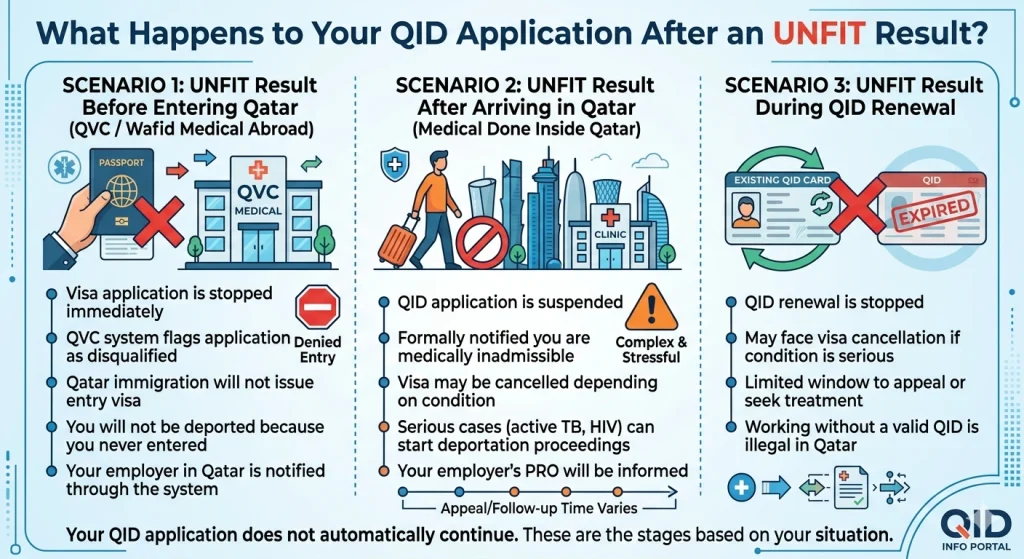
Your QID application does not automatically continue. Here is exactly what happens at each stage depending on where you are in the process:
Scenario 1: UNFIT Result Before Entering Qatar (QVC / Wafid Medical Abroad)
If your medical was done outside Qatar through the Qatar Visa Center (QVC) or the Wafid/GAMCA system:
- Your visa application is stopped immediately
- The QVC system flags your application as disqualified
- Qatar immigration will not issue your entry visa
- You will not be deported because you never entered the country
- Your employer in Qatar is notified through the system
In this case, you are simply denied entry. The process stops before it starts.
Scenario 2: UNFIT Result After Arriving in Qatar (Medical Done Inside Qatar)
This is the more complicated scenario — and the more stressful one. If you already entered Qatar on a work visa and your medical done inside Qatar comes back UNFIT:
- Your QID application is suspended
- You are given a formal notification that you are medically inadmissible
- Depending on the condition, your visa may be cancelled
- In serious cases (active TB, HIV), deportation proceedings can begin
- Your employer’s PRO will be informed
The timeline between UNFIT result and visa cancellation varies. Some people are given time to appeal or do follow-up tests. Others — particularly in cases of serious communicable diseases — are processed for deportation relatively quickly.
Scenario 3: UNFIT Result During QID Renewal
If you are an existing resident renewing your QID and a routine renewal medical comes back UNFIT:
- Your QID renewal is stopped
- You may face visa cancellation if the condition is serious
- You have a limited window to appeal or seek treatment
- Working without a valid QID is illegal in Qatar
Top Reasons for UNFIT Result in Qatar Medical Test
Understanding why you failed is critical before taking any next step. Here are the most common causes:
1. Tuberculosis (TB) — السل
This is the most common reason for UNFIT results in Qatar. Qatar takes tuberculosis extremely seriously because of its public health implications. There are two sub-cases:
- Active TB — This is the most serious case. Active tuberculosis almost always results in visa denial and, if you are already inside Qatar, deportation.
- TB Scars / Old TB (Lung Scarring on X-Ray) — This is more complex. Old TB scars from a previous infection that was fully treated can sometimes be reviewed with medical documentation. However, many applicants with lung scars still receive UNFIT, especially without proof of completed treatment.
What to do: If you have a history of TB treatment, always carry your official treatment completion certificate. Submit it as part of any appeal process.
2. HIV / AIDS
HIV is a permanent disqualifying condition in Qatar. An HIV positive result results in:
- Immediate visa denial (if outside Qatar)
- Visa cancellation and deportation (if inside Qatar)
- A permanent ban from working in Qatar and most GCC countries
There is no appeal pathway for HIV in Qatar’s immigration system.
3. Hepatitis B (التهاب الكبد B)
Hepatitis B is a disqualifying condition in Qatar. Unlike the UAE (which has some exceptions for certain professions), Qatar does not allow residence permits for Hepatitis B positive applicants in most cases.
Important: A “Non-Reactive” result for Hepatitis B means you are negative — that is a normal, safe result. Only a “Reactive” or “Positive” result is disqualifying.
4. Hepatitis C (التهاب الكبد C)
Similar to Hepatitis B, a reactive Hepatitis C result is grounds for UNFIT in Qatar. While treatment for Hepatitis C has advanced significantly in recent years, Qatar’s immigration rules have not fully caught up — and the residency permit will typically be denied.
5. Syphilis
Syphilis detected in the blood test results in an UNFIT status. However, unlike HIV or Hepatitis, syphilis is a treatable condition. There is a possibility of re-testing after successful treatment and a waiting period.
6. Abnormal Chest X-Ray (Non-TB Findings)
Sometimes a chest X-ray shows abnormalities that are not TB but still flag the system — old lung scars, minor shadows, or incidental findings. In these cases:
- The applicant may be sent for additional tests (sputum test, skin PTB test, chest MRI)
- If additional tests are clear, the case may be resolved with a FIT result
- Documentation from your home country doctor helps
7. Pregnancy
Pregnant women who present for medical are often given a “Temporarily Unfit” status because chest X-rays cannot be performed safely during pregnancy. This is not a permanent disqualification. The process is typically deferred until after delivery.
UNFIT vs Temporarily UNFIT — What Is the Difference?
Qatar’s medical system actually has three possible negative outcomes — not just one:
| Status | Meaning | Next Step |
|---|---|---|
| UNFIT (غير لائق) | Hard fail — disqualifying condition found | Visa denied / cancelled |
| Temporarily UNFIT | Needs follow-up or re-test | Re-test after treatment or waiting period |
| Under Review / Further Tests Required | Inconclusive results — more tests needed | Additional tests at the medical center |
If your status is Temporarily UNFIT rather than a hard UNFIT, that is actually a much better situation. It means the system has not fully closed your case yet.
Can You Appeal a Failed Qatar Medical Test?
Yes — in some cases, you can appeal. But the success of an appeal depends completely on why you failed.
Appeals That Can Succeed
- Old TB scars with proof of completed treatment (official medical certificate)
- Inconclusive or borderline test results
- Technical errors (wrong sample, lab error)
- Minor, treatable conditions that have since been resolved
- Syphilis after successful treatment and a clean retest
Appeals That Almost Never Succeed
- Active HIV
- Active TB (without treatment completion proof)
- Active Hepatitis B (reactive result)
- Active Hepatitis C (reactive result)
The official appeal success rate for medical UNFIT results in Qatar is low — especially for the major infectious diseases. This is a public health policy decision, not a bureaucratic one.
How to File an Appeal — Step by Step
Step 1: Get the exact reason for your UNFIT result. Your employer or sponsor has access to the medical report. Ask them to share the specific findings.
Step 2: Consult a doctor — either at Hamad Medical Corporation (HMC) inside Qatar or a qualified specialist in your home country.
Step 3: Gather supporting documentation:
- Previous treatment records
- Medical certificates from your home country
- Clearance letters from your doctor
- Negative re-test results (if applicable)
Step 4: Your employer or company PRO submits an official appeal to the Medical Commission in Qatar. Individual applicants typically cannot appeal directly without employer support.
Step 5: Wait for the review. This process can take anywhere from 1 week to 6 weeks depending on the case complexity.
Step 6: If the appeal is approved, you will be asked for additional tests or a re-examination. If denied, the UNFIT decision stands.
What Happens If You Are Deported Due to UNFIT?
If you are already inside Qatar and your UNFIT result leads to visa cancellation and deportation:
- You will be issued an exit notice
- Your employer must provide an exit permit
- You will be required to leave Qatar within the specified period
- In most cases involving serious communicable diseases, a re-entry ban is placed on your passport
- Your name is registered in the Gulf Cooperation Council (GCC) health database
- This can affect your ability to get work visas in UAE, Saudi Arabia, Kuwait, Oman, and Bahrain as well — not just Qatar
This is why the UNFIT result — particularly for HIV, active TB, or Hepatitis B/C — is treated so seriously. It is not just a Qatar issue. It is a GCC-wide issue.
Can You Re-Apply to Qatar After an UNFIT Result?
This depends entirely on the reason for the UNFIT:
| Condition | Can Reapply? | Conditions |
|---|---|---|
| Active TB (treated) | Possibly | After completing full TB treatment + documentation |
| TB Scars | Possibly | With treatment completion certificate |
| Syphilis (treated) | Possibly | After successful treatment + negative retest |
| Hepatitis B | Very difficult | Generally permanent disqualification |
| Hepatitis C | Very difficult | Generally permanent disqualification |
| HIV | No | Permanent ban |
| Pregnancy | Yes | After delivery and medical clearance |
| Minor treatable conditions | Yes | After treatment and clean retest |
What Should You Do RIGHT NOW If You Got an UNFIT Result?
Follow these steps immediately — do not wait:
Step 1: Do not panic. Check whether your result says “UNFIT,” “Temporarily UNFIT,” or “Under Review.” Each has a different path forward.
Step 2: Contact your employer or PRO immediately. Do not try to handle this alone. Your employer has access to your full medical report and knows the specific disqualifying condition. This information is critical for deciding your next step.
Step 3: Find out the exact reason for the UNFIT result. The status alone tells you nothing. The reason tells you everything.
Step 4: Do NOT overstay your visa. If your visa or entry permit is still active, you are legally in Qatar for now. But if your QID application is cancelled, you must leave before your permitted stay ends. Overstaying will add fines and legal complications on top of the medical issue.
Step 5: Get a second medical opinion. Especially if you believe there may be an error — a lab mix-up, a false positive, or a misread X-ray. False positives, while rare, do happen.
Step 6: Compile your medical history. If you have previously treated any of the tested conditions (especially TB), gather all documentation immediately. Treatment completion certificates, specialist letters, and negative test results from your home country are powerful evidence in an appeal.
Step 7: Consider legal or immigration advice. For complex cases, especially those involving deportation proceedings, consulting an immigration lawyer or a professional PRO firm in Qatar can be worthwhile.
How to Avoid a Failed Qatar Medical Test — Prevention Tips
While you cannot control everything, here are practical steps to give yourself the best chance of a FIT result:
- Get a pre-medical check-up in your home country before your official Qatar medical. This gives you advance warning of any issues.
- Complete treatment for any known condition before applying. Do not apply while still under treatment for a communicable disease.
- Carry documentation of any previous serious illness that was fully treated — especially TB.
- Stay healthy before the test: avoid alcohol, fatty foods, and dehydration before your blood test.
- Be honest on your medical history form. Hiding conditions and being caught is worse than declaring them upfront.
- Do not apply if you have an active infectious disease. Wait until you are fully treated and have clean test results.
Summary — What Happens After Qatar Medical Test Failed
| Situation | What Happens | What You Can Do |
|---|---|---|
| UNFIT before entering Qatar | Visa not issued | Appeal with documentation / Re-apply after treatment |
| UNFIT after arriving in Qatar (minor condition) | QID suspended | Appeal, follow-up tests, PRO support |
| UNFIT after arriving in Qatar (HIV/TB/Hep) | Visa cancelled, deportation possible | Consult PRO / Lawyer immediately |
| Temporarily UNFIT | Further tests required | Complete additional tests at Medical Commission |
| UNFIT during QID renewal | Renewal stopped, visa may be cancelled | Appeal with medical documentation |
Common Questions People Ask After Getting UNFIT
Q: Does an UNFIT result mean I am automatically deported?
A: Not always and not immediately. Deportation typically follows if you are already inside Qatar AND the condition is serious (HIV, active TB). In many cases, there is a window for appeals, follow-up tests, or voluntary departure.
Q: Will my employer know why I failed?
A: Yes. The employer or sponsor receives the medical report which includes the specific findings. There is no privacy protection for immigration medical results in Qatar.
Q: Can I hide a medical condition and re-apply?
A: No. Qatar shares medical data within the GCC health database system. Trying to re-apply while hiding a disqualifying condition is immigration fraud and can result in a permanent GCC-wide ban.
Q: Does diabetes or high blood pressure cause an UNFIT result?
A: Generally, no. Diabetes and high blood pressure alone are not grounds for UNFIT in Qatar’s standard immigration medical tests. The tests specifically screen for infectious communicable diseases.
Q: What if I had TB in the past but am fully cured?
A: Fully cured TB with proper documentation is not automatically disqualifying. However, TB scars on an X-ray will still trigger additional testing. Having your treatment completion certificate and specialist letters ready is essential.
Q: Can I work while my UNFIT appeal is being processed?
A: No. Without a valid QID or residence permit, working in Qatar is illegal. Do not work during an unresolved UNFIT status.
Q: Is the UNFIT result shared with other GCC countries?
A: Yes. The Wafid/GAMCA system is shared across Saudi Arabia, UAE, Kuwait, Qatar, Oman, and Bahrain. An UNFIT for serious conditions in Qatar typically affects your ability to get work visas in other GCC countries as well.
Q: My friend had the same condition and passed. Why did I fail?
A: Test sensitivity, the specific level of infection markers, and the medical center’s protocols can vary. A borderline result may go different ways for different people. This is exactly why appeals and re-tests exist.
Conclusion
Getting an UNFIT result on your Qatar medical test is frightening — but it is not always the end of the road.
The most important thing you can do right now is find out the exact reason for your failure. That single piece of information determines everything that follows: whether you can appeal, whether you can re-test, whether you face deportation, and whether Qatar is still a possibility for you at all.
Work with your employer’s PRO, be honest, gather your medical documentation, and take action quickly. Time matters when your visa status is in question.
If your condition is treatable, there is a path forward. If it is not, it is better to know that clearly so you can make informed decisions about your future.