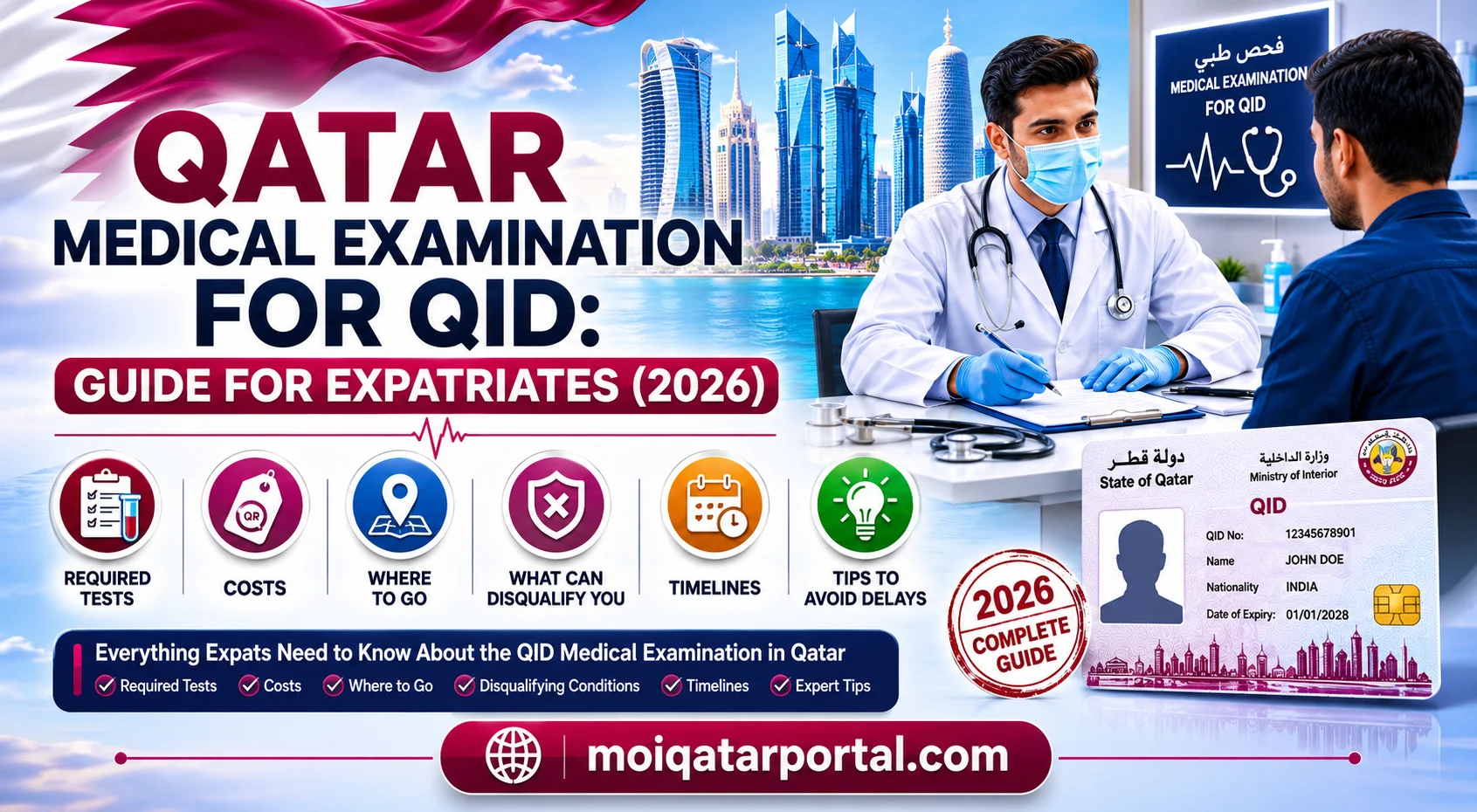
Qatar Medical Examination for QID: Guide for Expatriates (2026)
Moving to Qatar for work, family sponsorship, or long-term residence involves several important steps before receiving a Qatar ID (QID). One of the most important requirements is the Qatar Medical Examination for QID, administered under the oversight of the Ministry of Interior Qatar (MOI). Every year, thousands of expatriates arrive in Qatar and must complete mandatory health screening before their residence permit and QID can be issued.
Many newcomers are unsure about what happens during the medical examination, which tests are required, how long the process takes, and what happens if additional screening is needed. Understanding these requirements before your appointment can help you avoid delays and complete your residency process smoothly.
This guide explains the medical tests required for a Qatar ID in 2026, who must undergo screening, how the process works, common reasons for delays, and answers to the most frequently asked questions.
What Is the Qatar Medical Examination for QID?
The Qatar Medical Examination is a mandatory health screening that forms part of the residence permit application process. Before your Qatar ID (QID) can be issued, the Ministry of Public Health (MOPH) requires that you pass this examination.
The screening exists primarily to protect Qatar’s public health infrastructure. It is not a fitness-for-work test or a comprehensive medical evaluation — it is a targeted screening for specific communicable conditions that Qatar monitors as a matter of national health policy.
Passing the examination clears one of the final bureaucratic gates between your arrival and your legal residency status.
Who Is Required to Take the Examination?
Medical screening is mandatory for the following categories:
| Residency Category | Medical Exam Required? |
|---|---|
| Employed expatriate workers | Yes |
| Domestic workers (housemaids, drivers, nannies, cooks) | Yes |
| Sponsored family members (spouse, dependents) | Yes (in most cases) |
| International students on long-term residency | Often yes |
| Individuals transferring between sponsors | Often yes |
| Short-term visitors / tourists | No |
| Qatari nationals | No |
Important: Requirements can change. Always confirm your specific category with your sponsor, employer, or HR department before your appointment.
Where Is the Medical Examination Conducted?
In Qatar, medical examinations for residency are conducted at Primary Health Care Corporation (PHCC) facilities and designated health centers authorized by the Ministry of Public Health. Your sponsor or employer will typically direct you to the correct facility based on your location and visa category.
Major examination centers are located in:
- Doha (multiple PHCC clinics)
- Al Wakrah
- Al Khor
- Al Rayyan
Some large employers and free zone authorities (such as those in Qatar Free Zones Authority) may arrange group medical examinations through approved providers.
What Tests Are Required?
Despite what many newcomers expect, the Qatar residency medical examination is not a comprehensive health checkup. It is a focused screening consisting of two primary tests.
1. Blood Test
A blood sample is drawn and screened for specific communicable conditions that Qatar monitors as part of its public health and residency regulations.
What to know:
- The draw itself takes only a few minutes
- Fasting is generally not required, but confirm with your specific facility
- Your passport and visa details are verified before the sample is taken to ensure results are linked to the correct application
- Results are typically processed within a few working days
2. Chest X-Ray
A standard chest radiograph is taken to assess lung and chest health.
What to know:
- The imaging itself takes under five minutes
- You will be asked to remove metal objects and jewellery around your neck
- Women who are or may be pregnant should inform medical staff before the X-ray
- Results are reviewed by a radiologist before being submitted to the residency system
3. Identity and Document Verification
Before any tests are conducted, staff will verify:
- Your original passport (not a copy)
- Your visa status and entry stamp
- Your residency application reference (often provided by your sponsor)
This step is not a formality — mismatches between your passport details and your residency file will cause delays that can take days or weeks to resolve.
What Is NOT Included in the Examination
The examination does not assess:
- General fitness or physical capability
- Mental health
- Dental health
- Vision or hearing
- Employment skills or professional competency
- Academic qualifications
Do not worry about “passing” in the sense of being in peak physical health. The examination is narrow in scope.
How Long Does the Process Take?
| Stage | Typical Time |
|---|---|
| Registration and verification | 15–40 minutes |
| Blood test | 5–10 minutes |
| Chest X-ray | 5–15 minutes |
| Total time at the center | 1–3 hours (depending on queue) |
| Result processing | 3–7 working days typically |
| QID issuance after clearance | Varies by sponsor/employer |
Tip: Arrive early in the morning on a weekday to avoid peak queues. Avoid visiting immediately after public holidays when backlogs build up.
What Happens to Your Results?
Once your tests are completed, results are processed through the Ministry of Public Health’s system and linked electronically to your residency application. You generally do not need to collect a physical report or deliver it anywhere — the process is digital.
Three possible outcomes:
✅ Medical Clearance Issued
Your results meet Qatar’s residency requirements. Residency processing continues and your QID can proceed toward issuance.
🔄 Additional Screening Required
Your initial results have triggered a flag that requires further investigation. This does not automatically mean refusal — it means the system requires more information before clearance. You will be contacted with instructions. Additional tests, follow-up appointments, or repeat screening may be required.
❌ Medical Clearance Not Issued
In some cases, applicants are unable to receive clearance based on their results. This can affect your ability to obtain a Qatar residence permit. Your sponsor or employer will typically be notified, and you may have options to appeal or reapply depending on circumstances.
Common Reasons for Delays (and How to Avoid Them)
1. Passport Information Mismatch
If the name, date of birth, or passport number on your file does not exactly match your passport, your results may be held until the discrepancy is resolved.
Fix: Before your appointment, ask your sponsor or HR to confirm your details in the residency system match your current passport exactly — including middle names and transliterations.
2. Expired or Wrong Visa Category
If your visa status is not current or you are in the wrong residency processing queue, the examination may not be registerable in the system.
Fix: Do not attend the medical examination until your entry visa and sponsorship paperwork are confirmed and active.
3. High Volume Periods
Post-summer (August–September) and post-Ramadan periods tend to see very high volumes of new arrivals completing residency requirements simultaneously.
Fix: Schedule early morning appointments and be prepared for longer waits.
4. Incomplete Sponsor Documentation
Some examination centers require authorization documentation from your sponsor, particularly for domestic workers and family visa holders.
Fix: Ask your sponsor in advance what documentation they need to provide (not just what you need to bring).
5. Technical Delays in the MOPH System
Occasionally, electronic records take longer than usual to process and link to residency files.
Fix: Allow the standard processing window before following up. If more than 10 working days pass without update, request your sponsor to follow up through official channels.
What to Bring to Your Appointment
- ✅ Original passport (not a copy)
- ✅ Entry visa documentation
- ✅ Sponsor’s authorization letter or reference number (if required)
- ✅ Any appointment confirmation (SMS or printed)
- ✅ Printed or digital copies of your residency application reference
- ✅ Previous Qatar ID (if you are renewing or changing sponsor)
Leave at home: Large bags, food and drink (for waiting areas), and anyone who doesn’t have their own appointment — most centers have limited waiting space.
Special Situations
Pregnant Women
Inform medical staff immediately. Chest X-rays may be deferred or modified to minimize exposure. Your examination will be handled according to current MOPH guidelines for expectant mothers.
Individuals With Prior Medical Conditions
Existing conditions that are well-managed typically do not disqualify you. However, certain communicable conditions — if active — may result in additional screening or clearance being withheld pending treatment. Disclose relevant conditions to medical staff; this helps rather than hurts your case.
Domestic Workers
Domestic workers generally undergo the same core examination as other expatriate workers. However, their process is often arranged directly by the sponsoring household rather than an employer HR department. Sponsors should confirm the correct facility and documentation requirements in advance.
Children and Minors
Requirements for minors vary. Check with your sponsor or the relevant MOPH guidelines for the applicable age thresholds and screening requirements for dependents.
Frequently Asked Questions
Can I get a QID without completing the medical examination?
No. For the vast majority of residency categories, medical clearance is a prerequisite for QID issuance.
How will I know my results?
Results are typically communicated through your sponsor, employer, or HR system once they are available in the MOPH database. Some applicants can also check status through the Metrash2 app or the MOPH portal.
What happens if I fail?
“Failing” typically means additional screening is needed, not an automatic deportation or residency denial. Depending on findings, you may be referred for treatment, further testing, or additional review. Speak with your sponsor if this occurs.
Can I work before receiving my QID?
This depends on your visa type and employer. Some work categories allow work to begin under the original work visa, while others require QID issuance first. Confirm with your employer’s HR team.
Is the examination the same for everyone?
The core tests are consistent, but there can be procedural differences between facilities and based on visa category. The underlying tests — blood test and chest X-ray — are standard across categories.
Do I need to repeat the examination when renewing my QID?
Generally no, but if you have been outside Qatar for an extended period or are changing visa category, additional screening may be required. Your sponsor will advise.
Is the process paperless?
Largely yes. Results go directly into the MOPH system and are linked to your residency application electronically. However, carry your documents anyway — physical verification is still done at the start of your appointment.
How much does it cost?
Fees vary by facility and may be covered by your employer or sponsor. Confirm with your sponsor who bears the cost before your appointment. Domestic workers’ fees are typically covered by the sponsoring household.
Checklist: Before Your Appointment
- Confirm your appointment date, time, and location with your sponsor
- Verify your personal details in the residency system match your passport exactly
- Gather all required documents (see list above)
- Ask your sponsor what documentation they need to provide
- Check if any additional sponsor authorization forms are needed
- Plan to arrive 15–20 minutes before your appointment time
- Inform medical staff of any pregnancy or relevant medical conditions
After You Pass: What Comes Next?
Medical clearance is one of the final steps before full residency is processed. After clearance:
- Your residency application moves forward in the MOPH/Ministry of Interior system
- Your sponsor completes any remaining administrative steps
- Your Qatar ID (QID) is issued — either collected in person or delivered depending on current procedures
- You can then access QID-gated services: bank accounts, driving licence applications, and other official documentation
Keep your QID secure once received. It is your primary identification document for virtually all official interactions in Qatar.
Final Word
The Qatar Medical Examination for QID is not something to be anxious about — for most people, it is a short, straightforward appointment that takes a morning. But preparation matters. Mismatched documents, missing sponsor paperwork, or incomplete information are the most common causes of delays, and all of them are avoidable.
Arrive prepared, verify your details in advance, and the path from examination to Qatar ID is usually smooth.