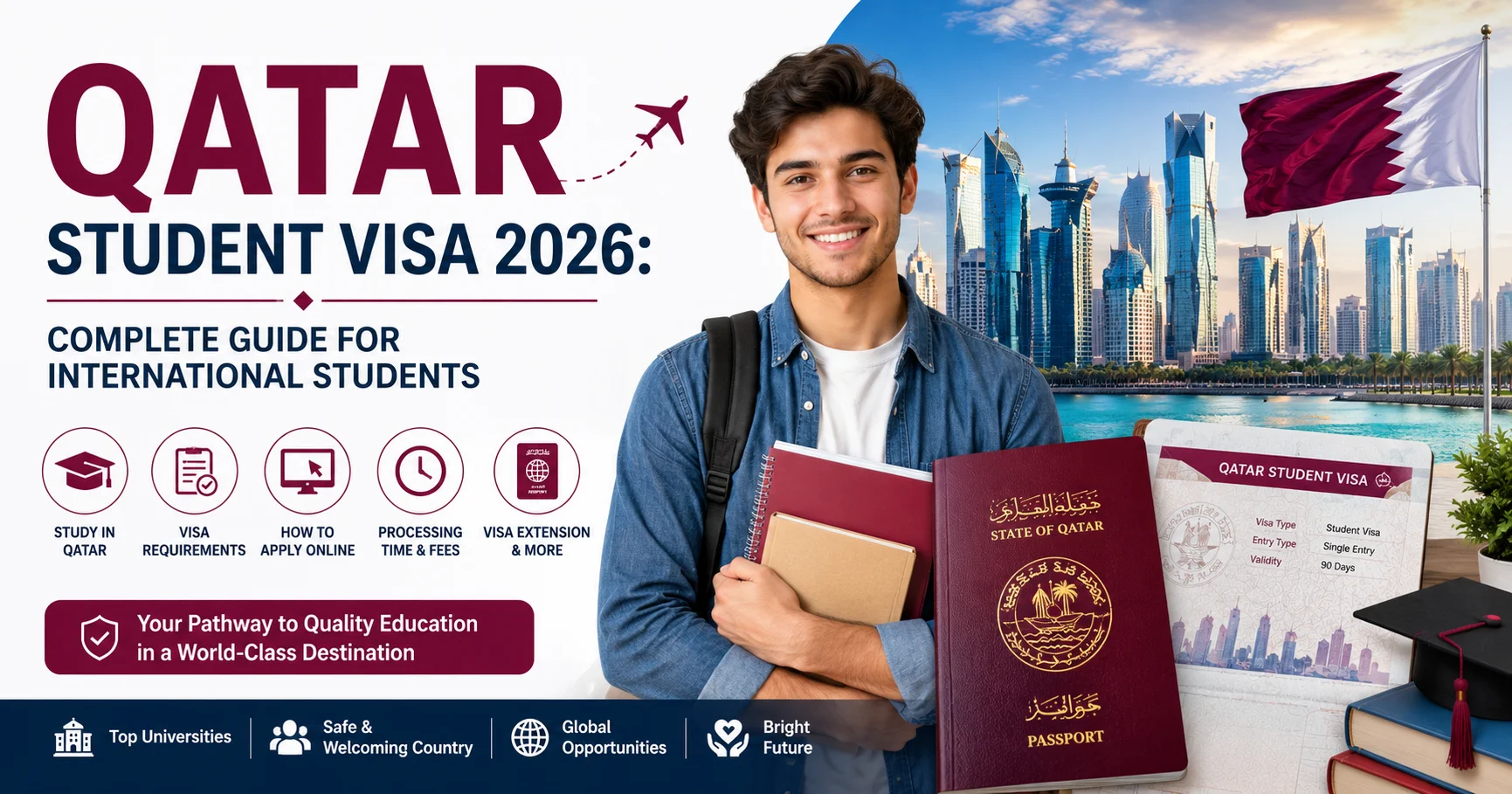
Qatar Student Visa 2026: Complete Guide for International Students
Studying in Qatar has become one of the most attractive options for international students, thanks to its world-class universities, scholarship opportunities, and growing reputation as an education hub in the Gulf. But before you can step into a Qatari classroom, you need to understand one critical requirement: the Qatar Student Visa.
This guide breaks down everything you need to know — from eligibility and required documents to fees, processing times, MOI Qatar portal status checks, and renewal — so you can apply with confidence and avoid common mistakes that delay approval.
Whether you’re a student from Pakistan, India, Bangladesh, the Philippines, or anywhere else in the world, this article covers the complete, up-to-date process for 2026.
What is a Qatar Student Visa?
A Qatar Student Visa is an official entry and residence permit issued by Qatar’s Ministry of Interior (MOI) that allows international students to legally enter Qatar, enrol in an accredited educational institution, and reside there for the duration of their studies.
It is sometimes referred to as a Qatar study visa or, after arrival, converted into a Qatar student residence permit (Qatar ID). Unlike a tourist visa, a student visa is tied directly to your enrollment at a recognized Qatari university or institution, which typically acts as your official sponsor throughout the process.
Key facts about the visa:
- It is mandatory for all non-Qatari, non-GCC nationals studying in Qatar.
- It is sponsored either by the university or by a financial guarantor (parent, relative, or scholarship body).
- It must be converted into a residence permit shortly after arrival.
- It allows access to healthcare, banking, and other resident services in Qatar.
Who Can Apply?
The Qatar student visa is open to:
- International students accepted into an accredited Qatari university (e.g., Qatar University, Hamad Bin Khalifa University, or branch campuses in Education City such as Georgetown, Northwestern, or Texas A&M).
- Students pursuing undergraduate, postgraduate, diploma, or recognized language/foundation programs.
- Scholarship recipients sponsored by a Qatari institution or government program.
- Students whose education is funded by a parent, relative, or approved sponsor residing in Qatar or abroad.
You generally cannot apply for a student visa without first securing an unconditional admission letter from a recognized institution. Conditional offers are usually not accepted by the MOI.
Eligibility Requirements
Below are the latest eligibility requirements for the Qatar student visa:
| Requirement | Details |
|---|---|
| Admission status | Unconditional admission letter from a Qatar-accredited university |
| Passport validity | Valid for at least 6 months beyond the intended length of stay |
| Age limit | No fixed legal maximum; most universities require 17–18 years minimum for undergraduate entry |
| Financial proof | Sponsor must show sufficient funds for tuition and living costs |
| Health status | Free from infectious diseases (confirmed via medical test) |
| Criminal record | Police clearance certificate (mandatory for most nationalities, including India, Pakistan, Bangladesh) |
| Sponsorship | A third party (university, parent, relative, or scholarship) — students cannot self-sponsor |
Important: Self-sponsorship is not permitted. Qatar University and most institutions require that financial support come from someone other than the student themselves, with proof of relationship and ability to pay.
Qatar Student Visa Age Limit
There is no universal upper age limit set by the MOI for student visas. However, individual universities may set their own minimum age requirements (commonly 17 for undergraduate programs). Postgraduate and PhD applicants face no special age restriction beyond standard admission criteria.
Required Documents
Here is the standard list of documents required for the Qatar student visa:
- Unconditional admission/confirmation letter from the university
- Valid passport (minimum 6 months validity, with at least one blank page)
- Passport-size photographs (white background, per Qatar visa specifications)
- Proof of financial support — bank statements, sponsorship letter, or scholarship award letter
- Sponsor’s passport or Qatar ID copy (if sponsor resides in Qatar)
- Sponsor’s bank statement or salary certificate
- Medical/health report (blood test, chest X-ray, and HIV test from an approved center)
- Police clearance / good conduct certificate from the home country
- Attested academic transcripts and certificates
- Completed student visa application form
- Parental consent letter (for minors or first-degree program applicants)
- Signed Student Declaration Form (required by some universities)
Documents Required for Pakistani and Indian Students
| Document | Pakistani Students | Indian Students |
|---|---|---|
| Admission letter | Required | Required |
| Attested academic certificates | HEC + MOFA + Qatar Embassy attestation | HRD/MEA attestation often required |
| Police clearance certificate | Required | Required |
| Financial sponsorship proof | Required | Required |
| Medical test report | Required | Required |
Tip: Document attestation is one of the biggest causes of delay for Pakistani and Indian applicants. Start the attestation process at least 4–6 weeks before your intended application date.
Application Process Step by Step
Here’s exactly how to apply for a Qatar student visa:
- Secure admission — Apply to and receive an unconditional offer from a Qatar-accredited university.
- Gather documents — Collect your passport, financial proof, medical clearance, and academic records.
- Submit application — Apply online through the university’s international/admissions office, the Qatar e-Visa portal (qatarevisaonline.com), or through the nearest Qatari Embassy.
- Pay applicable fees — Cover any visa processing or administrative charges (most universities charge no separate “visa fee,” but related costs apply).
- Undergo medical examination — Complete blood test, chest X-ray, and HIV screening at an approved clinic.
- Wait for MOI review — The Ministry of Interior reviews and approves the entry permit, usually coordinated through your university.
- Receive electronic entry permit — Print this document; it’s required for boarding your flight and for immigration at the airport.
- Travel to Qatar — Enter using your passport and entry permit within the validity window stated on the permit.
- Complete residence formalities — Within 7–14 days of arrival, undergo fingerprinting, another medical check, and submit documents to convert your entry permit into a Qatar student residence permit (QID).
Qatar Student Visa Application Form
The application form is typically provided by your university’s admissions office or accessible via the Qatar e-Visa portal. It requires personal details, passport information, sponsor details, and program information. Always double-check spelling of your name and passport number — mismatches are a leading cause of rejection.
Processing Time
| Stage | Typical Duration |
|---|---|
| Entry permit (via Qatar e-Visa portal) | As fast as 72 hours for straightforward cases |
| Full visa process (university-coordinated) | 2 to 6 weeks, depending on nationality and document readiness |
| Residence permit (QID) after arrival | 7 to 14 days |
Qatar student visa processing time in 2026 can vary based on nationality, application volume, and how quickly documents are submitted. Applying early — ideally 6–8 weeks before your intended travel date — significantly reduces the risk of delays.
Fees and Charges
There is generally no standalone government fee charged solely for the student entry visa, but applicants should budget for associated costs:
| Item | Approximate Cost (QAR) |
|---|---|
| Medical examination | 100–250 |
| Document attestation (home country) | Varies by country |
| Residence permit (QID) issuance | 200–500 |
| Health insurance (mandatory in many cases) | Varies by provider |
| Visa-related administrative fee (if applicable) | 600–1,000 |
Qatar student visa fee for Pakistani students and other nationalities mainly comes from attestation and courier costs in the home country, rather than a Qatar-side visa charge. Scholarship recipients often have most or all of these fees waived.
Important: Visa fees, where applicable, are generally non-refundable even if your application is rejected. Always verify current charges directly with your university’s admissions office, as costs can change.
Validity and Renewal
- Initial validity: The entry permit is typically valid for single entry within a limited window (often 30 days) for the holder to travel to Qatar.
- Residence permit validity: Once converted, the Qatar student residence permit is usually issued for 1 year, matching the academic year, and is renewable annually for the duration of the study program.
- Qatar student visa renewal: Renewal must be completed before expiry through your university’s student affairs office, which coordinates with the MOI. Required documents typically include proof of continued enrollment, updated financial proof, and a valid medical certificate.
Common renewal mistakes to avoid:
- Waiting until the last week before expiry to start renewal
- Failing to maintain continuous enrollment status
- Not updating sponsor financial documents
How to Check Visa Status on MOI Qatar Portal
You can perform a Qatar student visa status check using the official MOI Qatar visa inquiry portal. Here’s the step-by-step process:
- Visit the official MOI website at moi.gov.qa.
- Click on “Inquiries” in the main menu.
- Select “Visa Services” from the dropdown.
- Click “Visa Inquiry & Printing.”
- Choose your search method — Visa Number or Passport Number.
- Enter your 15-digit visa number, or your passport number plus nationality.
- Complete the CAPTCHA verification.
- Click Submit to view your visa status instantly.
Your result will show the visa type, approval stage, validity dates, and sponsor information.
Alternative methods:
- Qatar Visa Center (QVC): At qatarvisacenter.com — useful for applicants from India, Pakistan, Bangladesh, Nepal, Sri Lanka, and the Philippines; tracks medical and biometric stages too.
- Metrash2 App: The MOI’s official mobile app for residents already holding a Qatar ID — allows quick status checks from a smartphone.
Common status messages:
| Status | Meaning |
|---|---|
| Under Process | Application is being reviewed |
| Approved / Valid to Use | Visa issued — ready to travel or print |
| Rejected | Application denied — review reason and consider reapplying |
| Expired | Validity window has passed without entry or renewal |
Tip: If you see “No Records Found,” double-check that you’ve selected the correct nationality and entered your passport number exactly as printed (including leading zeros or letters).
Common Reasons for Rejection
Avoid these frequent mistakes that lead to visa rejection or delay:
- Submitting a conditional admission letter instead of an unconditional one
- Incomplete or mismatched financial sponsorship documents
- Passport validity shorter than the required 6 months
- Missing or improperly attested academic certificates
- Incorrect or inconsistent personal details across documents
- Failing the medical examination or submitting outdated medical reports
- Applying for self-sponsorship instead of third-party sponsorship
- Long delays between document issuance and submission, causing them to expire
Tips for Faster Approval
- Apply early — Start at least 6–8 weeks before your intended travel date.
- Double-check every document for spelling, dates, and consistency before submission.
- Use your university’s international office — they have direct experience with MOI requirements and can flag issues before submission.
- Complete attestation early, especially if you’re a Pakistani or Indian student, as this step often takes the longest.
- Secure accommodation in advance — having confirmed housing in Qatar can support a smoother application.
- Keep emergency funds documented — showing buffer funds beyond tuition strengthens financial proof.
- Track your status regularly on the MOI portal rather than waiting for updates from third parties.
Frequently Asked Questions
Q: How do I apply for a Qatar student visa?
A: Secure unconditional admission from a Qatar-accredited university, gather required documents (passport, financial proof, medical report, police clearance), and submit your application through your university’s international office or the Qatar e-Visa portal.
Q: What documents are required for the Qatar student visa?
A: Key documents include a valid passport, admission letter, proof of financial sponsorship, medical examination report, police clearance certificate, and attested academic transcripts.
Q: What is the Qatar student visa fee?
A: There is typically no separate government fee for the visa itself, though associated costs like medical tests, document attestation, and residence permit issuance apply, generally ranging from QAR 600–1,000 depending on the case.
Q: How long does Qatar student visa processing take?
A: Processing can take as little as 72 hours through the e-Visa portal for straightforward cases, though the full process — including university coordination — typically takes 2 to 6 weeks.
Q: How can I check my Qatar student visa status online?
A: Visit moi.gov.qa, go to Inquiries > Visa Services > Visa Inquiry & Printing, and enter your visa number or passport number with nationality to view real-time status.
Q: What is the validity of a Qatar student visa?
A: The entry permit is valid for a limited entry window, while the converted residence permit is typically valid for one year and renewable annually for the duration of your studies.
Q: Can international students work in Qatar on a student visa?
A: Some universities allow limited part-time work with prior permission from the institution and the MOI, but this is restricted and must comply with Qatar’s labor regulations. Always confirm with your university before taking any job.
Q: Can I renew my Qatar student visa?
A: Yes. Renewal is processed through your university’s student affairs office before expiry, requiring proof of continued enrollment, updated financial documents, and a valid medical certificate.
Q: Is there an age limit for the Qatar student visa?
A: There is no fixed government-wide maximum age limit, though universities may set a minimum age (commonly 17) for undergraduate admission.
Q: What is the Qatar student visa fee for Pakistani students specifically?
A: Pakistani students generally face the same general cost structure as other nationalities, with additional expenses tied to document attestation through HEC, MOFA, and the Qatar Embassy in Islamabad.
Final Verdict
The Qatar student visa process is straightforward when approached methodically: secure unconditional admission, prepare accurate and complete documents, undergo your medical examination promptly, and apply well ahead of your intended travel date. Most delays stem from incomplete paperwork or last-minute attestation issues rather than the visa process itself.
Use the official MOI Qatar portal for all status checks, rely on your university’s international office for guidance, and keep buffer time in your planning. With the right preparation, your transition to studying in Qatar can be smooth, efficient, and stress-free.